The cow: the silent maker of civilisation
 Surbhi Sewa·
In today's world the cow is often seen only as an animal that gives milk, and her worth is settled by production figures. But that way of seeing is incomplete. The cow does not give milk alone. She has played a central part in the making, the survival and the advance of human civilisation. This is not an emotional claim but a fact tied to history and to science.
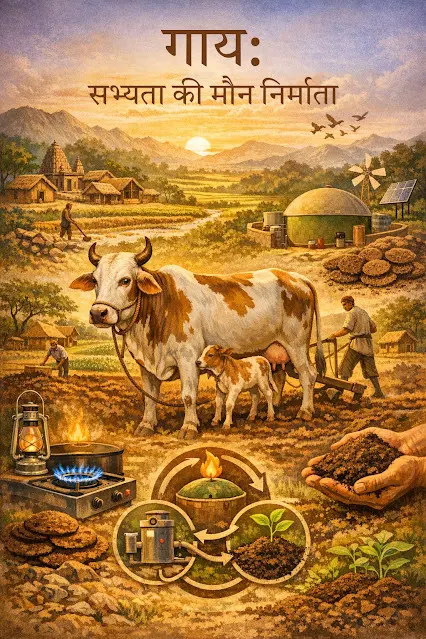
When human society moved out of a wandering life towards settled habitation, farming began, villages were founded and social structure took shape. The cow stood at the centre of that change. Traditional farming was not possible without the cow, and civilisation could not have developed without farming. So wherever settled human society grew, the presence of cattle was there as a matter of course.
Science today accepts that soil is a living system. Cow dung keeps that system alive and working. The microorganisms in it raise the fertility of the soil, improve its capacity to hold water, and balance the long-term damage done by chemical farming. This is why the modern world is today turning back towards organic and regenerative farming.
The whole life cycle of the cow is a working model of sustainability. Dung makes biogas, biogas gives clean energy, and what is left becomes manure for the soil once more. It is a circular system in which nothing goes to waste: exactly the thinking that is needed in this age of climate crisis.
Economically and socially too the cow gives village life its steadiness, supports local employment and keeps a person connected to nature. A life lived alongside the cow teaches balance, patience and calm: the very things slowly being lost in a fast, screen-driven world.
Civilisation is not built of technology and buildings alone. It is built of values and of balance. To think of the cow as only an animal that gives milk is like thinking of a tree as only timber.
Originally published: surbhi-sewa.blogspot.com