Socrates to Aristotle: a journey of thought
 Surbhi Sewa·
In the tradition of Western philosophy a remarkable sequence appears: Socrates, Plato and Aristotle. This is not the tale of three men alone, but a journey through three stages of thinking. One awakened questions, the second gave shape to ideas, and the third carried them into life and into science. To understand this sequence is to understand the whole process of knowledge: how the mind wakes, how thought forms, and how in the end the direction of a life is changed.
Socrates: the question and the awakening
Socrates is the beginning of this journey. He believed that true knowledge cannot be handed over from outside; it lies within the person already, and is awakened through the right questions. He put questions to people so that a person would begin to think for himself. For him philosophy meant this: to examine one's own life, to test one's own thinking, and to stay honest in the search for truth.
His famous saying is this:
"I know only that I know nothing." This sentence is not an admission of ignorance but the beginning of awareness. Knowledge is born exactly where ego ends. Socrates said that an unexamined life stays incomplete. He wrote no treatise; his questions became his legacy. He was less a teacher than a seeker of awakening. He shows us that the first spark of thought is born from a question.
Plato: the idea and the direction
Plato, the student of Socrates, gave that awakening a direction. He understood that if questions are given no form and no structure, they can scatter. So he set out an ordered philosophy of ideas and ideals. In his view this visible world is changeable, while truth and the ideal are lasting.
One of his principal ideas was this:
"Knowledge is virtue."
And he indicates too that reality is not only what the eyes can see, but also what the intellect understands. Plato thought deeply about justice, the state, the soul and knowledge, and founded an academy where ideas could be developed in an ordered way. He gave curiosity a direction. He gave the awakening form and foundation.
Aristotle: balance and practice
Aristotle, the student of Plato, brought this journey down to the ground. He said that ideas matter, but experience and observation matter just as much. He studied nature, logic, politics, ethics and science, and tied knowledge to the conduct of life.
His famous saying is this: "We are what we repeatedly do; excellence, then, is not an act but a habit." And his core principle was this: "The best path in life is the middle path." Aristotle did not let philosophy remain contemplation alone; he made it a method of living and the foundation of science. He joined thought to practice and carried reflection into daily life.
The flow of all three
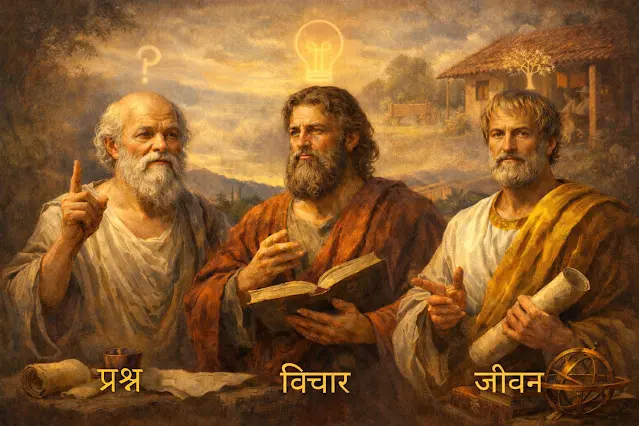
Seen together, a clear sequence appears: Socrates teaches how to question, Plato shows how to understand and shape ideas, and Aristotle tells us how to put ideas into practice.
Or to put it another way:
Socrates wakes the mind, Plato gives the mind direction, and Aristotle gives the mind balance and a foundation.
The complete journey of knowledge
Knowledge is not an event, it is a journey. First the mind wakes, then thought becomes clear, and in the end those same thoughts take shape as a way of life. From question to understanding, and from understanding to conduct: that is the full circle of knowledge.
In closing
Only when the mind has the courage to question, the patience to understand and the humility to live it out does philosophy come alive. Socrates teaches us to wake, Plato teaches us to see, and Aristotle teaches us to live. When all three are understood together, knowledge no longer stays a thought. It becomes a way of living, and thinking goes beyond philosophy to become the very nature of life.
Originally published: surbhi-sewa.blogspot.com