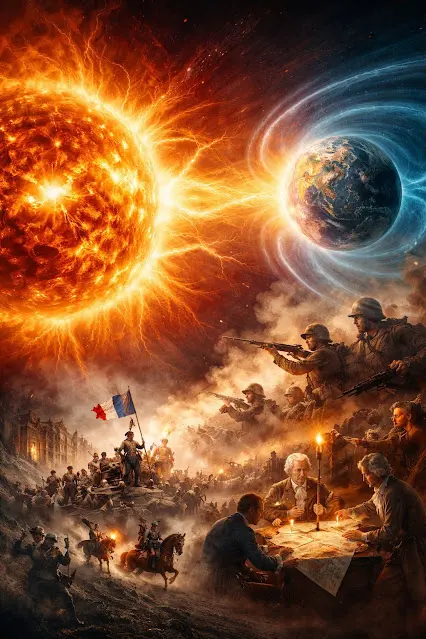
The cycle of the sun and human history
 Surbhi Sewa·
Do the activities of the sun influence the great events of the world? Human history has seen many periods when the world passed suddenly through great changes: wars, revolutions, mass movements and shifts of power. Ordinarily these events are explained by politics, economics and social conditions. But some scientists put forward the idea that the causes behind these events may not lie with the earth alone, and that the activity of the sun may also carry some subtle influence. The scientist who advanced this idea was Alexander Chizhevsky. Studying several centuries of history, he tried to understand whether a connection could exist between solar activity and the turbulence of human society.
Who Alexander Chizhevsky was
Alexander Chizhevsky was born in Russia in 1897. Besides being a scientist he was a thinker and a researcher. He studied the relationship between the sun and living systems, and for this reason he is counted among the pioneering scientists of heliobiology. Under Soviet rule his ideas were not accepted. The country was then under the rule of Joseph Stalin. He was arrested in 1942 and had to spend roughly eight years in labour camps.
The eleven-year cycle of the sun
The basis of Chizhevsky's research was a natural cycle of the sun known as the solar cycle. It runs for roughly eleven years, in which the activity of the sun is at times quiet and at times intensely active. Chizhevsky held that roughly 80 per cent of the great revolutions and wars in history appear around the more active phase of the sun.
The principal events of five hundred years of history
Chizhevsky studied history from about 1500 to 1900. Many great global changes took place in that span.
The principal events are these:
- 1517: the beginning of the religious reform movement in Europe
- 1618–1648: the Thirty Years' War in Europe
- 1775–1783: the American War of Independence
- 1789: the great French Revolution
- 1803–1815: the Napoleonic wars
- 1848: widespread popular uprisings across Europe
- 1861–1865: the American Civil War
Although his original study ran only to 1900, later researchers looked for the same pattern in the history that followed. In this extended analysis these events too are often cited:
- 1914–1918: World War I
- 1939–1945: World War II
The magnetic influence of the sun and the earth
When the sun is intensely active, powerful events occur in space which are called solar storms. These can affect the magnetic environment around the earth, that is, the Earth's magnetosphere. Some researchers hold that in such conditions there may also be a slight effect on the atmosphere and on the collective emotional state of human society.
The possible direction of 2025–2030
The cycle the sun is passing through at present is called Solar Cycle 25.
According to scientists, the activity of this cycle may come close to its high point around 2024–2026. Some analysts hold that at such a time political, economic and social turbulence may appear relatively more often at the global level.
2025–2026
In this period competition over the global balance of power may increase. In some regions geopolitical tension, trade conflict, and pressure over energy and resources are likely to grow. Alongside this, rapid development and competition may be seen in space technology, artificial intelligence and defence technology.
2026–2027
Economic instability, political tension or social discontent may increase in some countries. Changes in international alliances and new strategic approaches may come to the fore.
2027–2028
Mass movements, changes of power or large social movements may be seen in some parts of the world. Technological change may also affect society rapidly.
2028–2029
A shift may appear in the global economic and technological balance of power. Some new regions may emerge as economic and industrial centres.
2029–2030
The solar cycle may move gradually towards its quiet phase. Along with it, a tendency towards relative stability and balance may also appear in global conditions.
Conclusion
Chizhevsky's theory suggests that the activity of the sun can affect the magnetic environment of the earth, and that this may carry a subtle influence on the collective mental state of human society. Modern science does not yet hold this idea to be fully proven; even so, the study of the possible connections between the sun and human history remains an interesting subject for scientists today.
Originally published: surbhi-sewa.blogspot.com