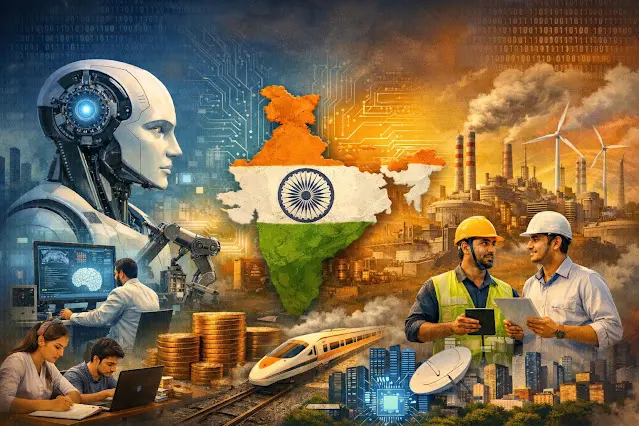
AI and India
 Surbhi Sewa·
The industrial growth of roughly the last hundred years rested mainly on human labour. The model by which Japan, Korea, Taiwan and China advanced was built on a foundation of cheap, disciplined and plentiful labour. In that era machines were an aid, not the deciding factor. So the countries that moved ahead industrially were the ones where labour was cheap, organised and available.
But today the conditions have changed at the root. AI, robotics and automation have changed the very nature of industrial growth. The basis of success is no longer the number of workers, but technology, data, research, policy stability and the quality of thinking. In this new age the old advantage of cheap labour is all but finished.
India's real challenge begins here. India's population is large, but it is not sufficiently educated, skilled and technology-ready. The number of people alone does not bring development: development comes from educated thinking, practical skill and responsible systems.
Alongside this, political and policy instability is one of India's greatest obstacles. The problem is not the government alone; it is the uncertainty of policy. Foreign investment does not come from speeches, it comes from trust. When rules change repeatedly, processes are complicated and justice is slow, investment does not go deep. As a result India gets assembly, but not core technology, design and patents.
Plans alone are not enough for industrialisation; it needs a strong ecosystem: dependable infrastructure, a clear and stable tax system, fast logistics, skilled human resources and the least possible unnecessary interference. In India industry often receives less support and more control, and innovation is obstructed by it.
The AI age is both an opportunity and a warning for India. If real coordination is not built between education, policy and industry, this age could increase unemployment rather than create jobs. India's road cannot be the same as China's, and perhaps it should not be. But for that India will have to build a serious, long-term strategy on its real strengths: software, data, the domestic market and service-based innovation.
The conclusion is plain. India's "number" will not arrive by itself. Not from population, not from slogans, not from comparison. India will move ahead only when:
- policy is stable and dependable
- education teaches both thinking and skill
- infrastructure matches the needs of the future
- and society gives real respect to labour, to knowledge and to innovation
This view is not pessimism. It is responsible awareness. In history, the countries that moved ahead were the ones that did not wait for their time, but prepared for it.
Originally published: surbhi-sewa.blogspot.com