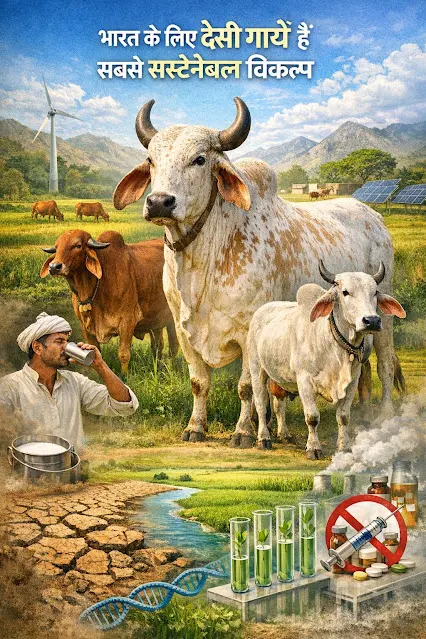
Why indigenous cows are the most sustainable choice for India
 Surbhi Sewa·
Indigenous cow breeds are slowly disappearing today, while foreign breeds have been assumed to be better for one reason only: they give more milk. But when the subject is looked at through genetics and long-term sustainability, the picture changes completely. India's indigenous breeds developed over thousands of years to suit the climate, the feed and the land of this very country, which is to say they are naturally suited to Indian conditions.
Indigenous cows carry in-built heat resistance in their genes. Through fierce heat, hot winds and shifting weather they hold their physical balance, while many foreign breeds fall quickly to stress and disease in Indian conditions. This is why foreign breeds need a cooler environment, more care and extra expense.
The disease resistance of indigenous cows is also naturally stronger. They fight local diseases better, which reduces dependence on medicines and antibiotics. The benefit does not stop with the farmer; it gives better results for milk quality and for the environment alike. On water and fodder too, indigenous breeds are the smarter choice: staying healthy on less water and on local fodder is a biological trait of theirs, while foreign breeds depend on more resources.
We often judge productivity by the quantity of milk alone, while science tells us that real productivity also includes health, lifespan, cost and environmental balance. Seen this way, indigenous cows become the more durable and dependable choice despite giving less milk. When a young person today thinks on the basis of data and science, it becomes plain that protecting indigenous breeds is not an emotional matter but a smart, scientific and future-ready decision.
Genetics says it plainly: the indigenous cow is not backward, she is the best fit for the conditions.
Originally published: surbhi-sewa.blogspot.com