Dharma, when it becomes part of an event
 Surbhi Sewa·
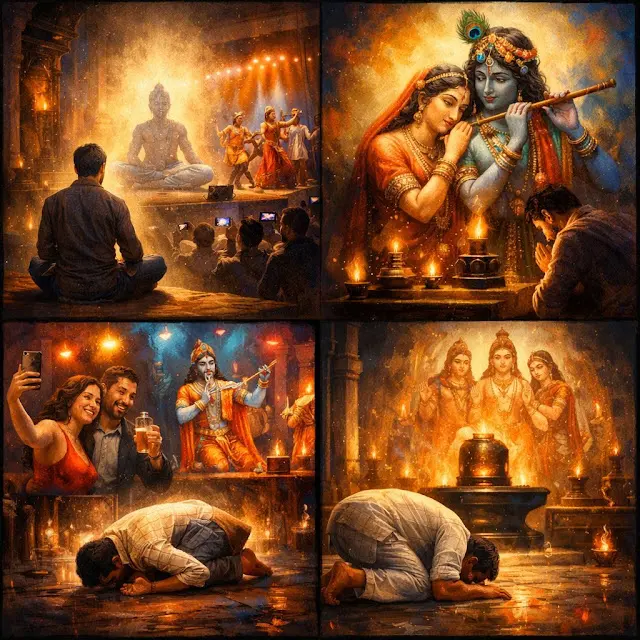
This is not a story from some ancient time. It is from only twenty or thirty years ago. When the actors who played Ram, Lakshman and Sita in the Ramayan serial were seen somewhere in ordinary life, people bowed their heads of their own accord. We knew they were performers, and still the feeling of the Ramayan was so alive and so sacred that the mind bent by itself. That bowing was not for the person; it was for the feeling in which divinity was held safe. But time has not changed very much. We have changed. Today we say: it is my wedding, it is my function, it is my stage. And Radha and Krishna become the ornament of our celebration, sometimes dancing with us, sometimes making us dance, as though it were not divinity but a performance. Once we could not stand before divinity at all; today we make it dance beside us. This change did not happen outside. It happened within. We cut Krishna away from action and discernment and bound him into dance and spectacle. And when Krishna became an event, the Gita fell silent. It is here that the hardest test of dharma begins: if God were to appear before us without leela, without a stage, without proof, would we bow? Or would we ask for proof first? In a society where proof is demanded even of God, the problem lies not with God but with how we see. Because when reverence thins, the demand for proof grows. God does not descend into noise; he appears in silence. God appears not in display but in surrender. Perhaps what is needed today is not new programmes but the old feeling. The feeling that did not stop at the idol, that moved past the form to seek the formless. God was not there in the seeing, and that is why he was there in the recognising.
Originally published: surbhi-sewa.blogspot.com